
Not the Time “Mads, honestly, this is not the time for aesthetics,” a fellow design researcher tells Mads Nygaard Folkmann (2026, p. 46). He sees her point. The climate is tipping, wars are destroying lives, we consume far too much. Who wants to talk about beauty now? In the studio the same attitude sounds quieter. Critiques say “coherent”, “functional”, “circular”. Hardly anyone says “beautiful”. It sounds like decoration, a luxury you allow yourself once the life cycle assessment is done. Folkmann has known this shyness for a while. Back in 2013 he wrote that attention to aesthetics can annoy designers because it implies their work is only about “surface, appearance, and styling” (p. 27). Design history, for its part, long avoided the subject for fear of being taken for pseudo art history (Folkmann, 2026, p. 47). Folkmann’s counterclaim is clear: aesthetics is central to understanding what design is and how it opens the world to us (p. 47). Mine is less comfortable. The fear of beauty has a look of its own. It is called arbitrariness.
Appearances Are Deep Folkmann swaps the narrow word form for appearance. Appearance, he argues, is multisensory, dynamic and tied into networks that reach beyond the object (2026, p. 49). His example is the Icehotel in Jukkasjärvi: ice works on the eye, but even more as cold on the skin. With Gernot Böhme he describes how things radiate into a space and generate atmosphere (p. 50). His shortest sentence on this: “Appearances are deep, so to speak” (p. 49). This is where my irritation with web colours begins, the ones that have pushed out material colours. A hex code does not radiate. It looks the same on every screen and smells of nothing. Folkmann also asks us to look behind the appearance. Behind the interface of an AI tool, algorithms are at work, and every prompt costs a lot of energy and around half a litre of water (p. 51). Foreground and background belong together. What matters is whether an appearance takes in its origins or erases them (p. 53).
Sugar Coating Drawing on the philosopher Wolfgang Welsch, Folkmann distinguishes two kinds of aestheticisation (2026, p. 56). The surface kind lays a “sugar coating of reality” over things: beautification and quick sensory appeal. The deep kind changes how we perceive reality in the first place. Folkmann’s example is INLAND ICE, bottled water from Greenland’s icebergs. The brand, he suggests, creates a distance from the product, even though the water really is special (pp. 55 f.). I have my own word for this, a Swiss German one: abgeschleckt, licked clean. Smooth radii, glossy surfaces, everything finished, nothing made. The electric car as a driving iPad belongs to the same family; more on that in “Auteur Design and the Cavallino”. Folkmann offers a sober category instead, “functional realism”: how honestly or dishonestly does a thing express its purpose (p. 58)? Dieter Rams put it more briefly in his third principle: “But only well-executed objects can be beautiful” (Vitsœ, n.d.). Which leaves the question whether that is already aesthetics, or just a good habit of people who love Braun radios.
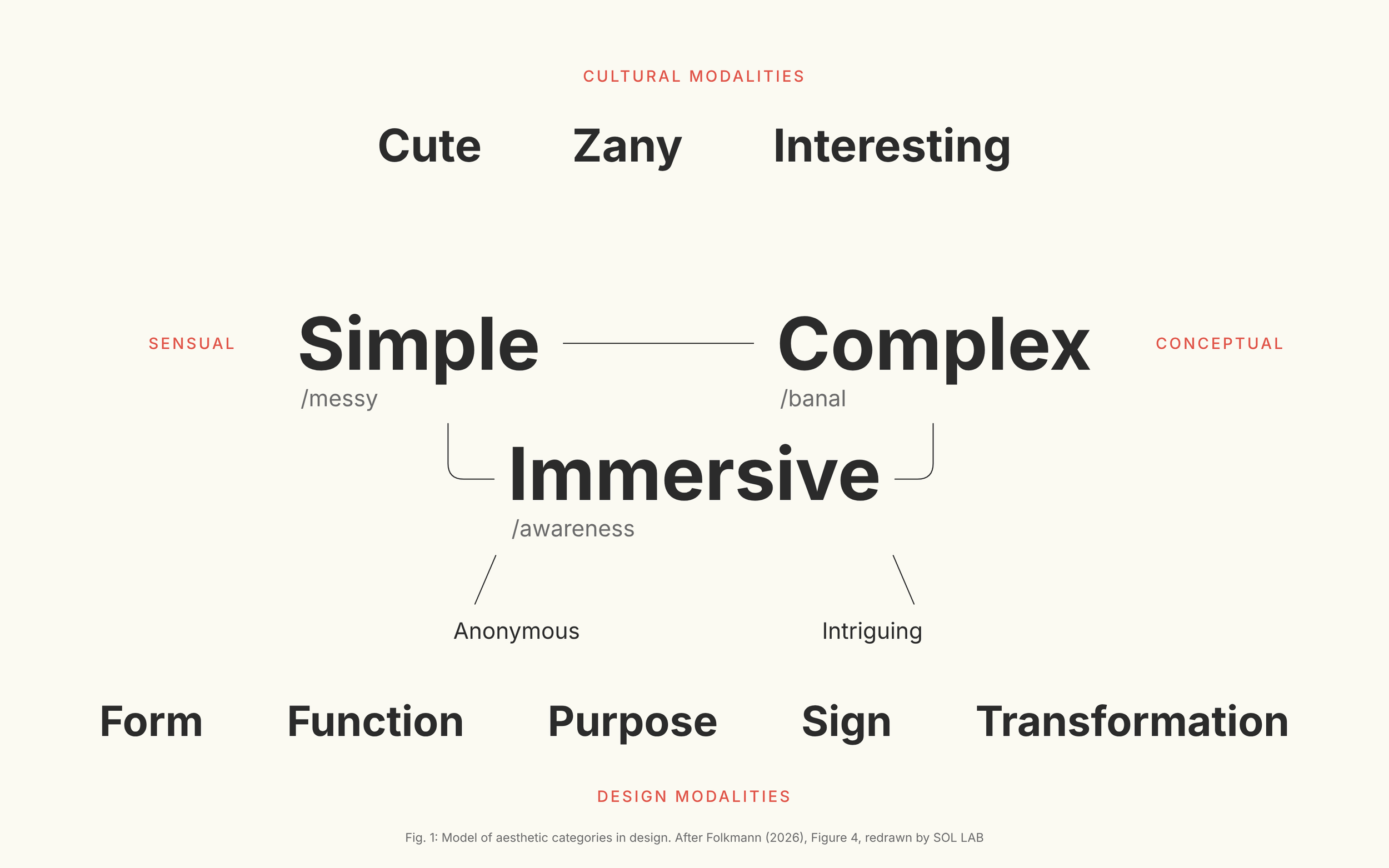
Minor Categories The strongest part of the article deals with categories. An aesthetic category, Folkmann says, frames what we experience as aesthetic at all. Change the category and the experience changes (2026, p. 57). He draws on Sianne Ngai (2012) and her three categories of the present: the cute, the interesting and the zany. The grand categories of the beautiful and the sublime give way to minor, weak, omnipresent ones. Ngai calls aesthetic experience in an age of design and advertising “less rarefied but also less intense” (2010, as cited in Folkmann, 2026, p. 58). For design, Folkmann proposes a triangle: the simple, the complex, the immersive. The simple has its counterpart in the messy, the complex in the banal (pp. 59 f.). Where the immersive meets the simple, something like the anonymous appears (p. 59). Is licked clean one of these minor categories of our time? Then arbitrariness would not be the absence of aesthetics but its most comfortable form.
Nothing Left to Chance Rams wrote down the antidote in his eighth principle: “Nothing must be arbitrary or left to chance” (Vitsœ, n.d.). Folkmann wrote as early as 2013 that “aesthetics is not just a question of appearance but also of epistemology” (p. 25), a way of ordering our relation to the world. In the studio this means fixing the material early, taking the sample in your hand, settling the language first and the specification second. It takes time. For me, luxury today is exactly that time, the process in which a decision becomes something you can justify. Folkmann closes with the thought that being unafraid of aesthetics lets us understand better what design is and means (p. 60). Perhaps that is too conciliatory. If every prompt costs water and his colleague is right that now is not the time for aesthetics, which luxury is the more expensive one: the beautiful or the arbitrary?
Sources
Folkmann, M. N. (2013). The aesthetics of imagination in design. MIT Press. https://doi.org/10.7551/mitpress/9292.001.0001 (full text, digital loan)
Folkmann, M. N. (2026). Who’s afraid of design aesthetics? Design Issues, 42(3), 46–60. https://doi.org/10.1162/desi.a.735 (full text)
Ngai, S. (2010). Our aesthetic categories. PMLA, 125(4), 948–958. https://doi.org/10.1632/pmla.2010.125.4.948 (cited in Folkmann, 2026)
Ngai, S. (2012). Our aesthetic categories: Zany, cute, interesting. Harvard University Press. (cited in Folkmann, 2026)
Vitsœ (n.d.). The power of good design: Ten principles for good design. https://www.vitsoe.com/gb/about/good-design (full text)
Figures
Fig. 1: Model of aesthetic categories in design. After Mads Nygaard Folkmann, “Who’s Afraid of Design Aesthetics?”, Design Issues, 42(3), 2026, p. 59, Figure 4. Redrawn by SOL LAB.
